Arts Collaborative Mini Grants

Arts Collaborative Mini Grants
Call for Proposals
No deadline


Arts Collaborative Mini Grants support new creative interdisciplinary projects and modes of collaboration. Teams must include participants from multiple academic departments and include a UGA student or faculty member to serve as a primary contact. Grant recipients are provided with a project mentor and up to $1000 in support for qualified expenses. Proposals will be reviewed on a rolling basis, pending the availability of funds.

Proposal form:
https://ugeorgia.ca1.qualtrics.com/jfe/form/SV_etzPEOTYrxYiVQa

Proposal requirements:

– Brief description of project, goals, and challenges

– Names and roles of collaborators

Special consideration will be given to proposals that engage the following themes:

– Zero Waste UGA (ZWUGA) initiative

– Artificial Intelligence (AI)

– Arts and health

– Arts and environmental issues

The Mini Grant Program is supported by the UGA Arts Collaborative, an interdisciplinary initiative for advanced research in the arts. The Arts Collaborative is supported in part by the Willson Center for Humanities and Arts, Franklin College of Arts and Sciences, and the Graduate School.

Continue reading “Arts Collaborative Mini Grants”

Interdisciplinary insights from the Arts Collaborative

Interdisciplinary insights from the Arts Collaborative
By Meredith Emery
https://research.uga.edu/news/interdisciplinary-insights-from-the-arts-collaborative/

What is the role of the arts in a research university? How can we sustain a culture of creativity and critical thinking?

These are questions that animate the University of Georgia Arts Collaborative, a network of faculty, students, and community members working together to advance interdisciplinary projects through engagement with the arts. Recently, to expand its role as a catalyst for creative research, the program launched a new, multi-year partnership with the Willson Center for Humanities and Arts.

Fall 2025 Mini Grants

Arts Collaborative Mini Grants support new creative interdisciplinary projects with mentorship and funding. Congratulations to the new mini grant recipients!

A call for proposals is open for 2025-26, pending the availability of funds.

Insect Zoo Mural Collaboration

The UGA Entomology department is teaming up with students from the Scientific Illustration program to create installations as part of the newly renovated Insect Zoo. This project seeks to connect the skills of scientific illustrators with the knowledge of entomologists to create a dynamic space that helps to educate and inspire visitors from as diverse of backgrounds as the bugs that are modeled.

Project participants

Kelly Carruthers, Entomology
Amanda Manowski, Art
Malcolm Peavy, Entomology
Seraphina Edwards, Art
Kayla Schlueter, Art
Mariah Yori, Art

Reclaiming Trees

This interdisciplinary project proposes to repurpose downed and salvage trees from UGA’s campus into usable wood products for students, faculty, community stakeholders to fostering sustainable practices and creative innovation. Currently, large woody debris is tub-ground for mulch, a process that emits greenhouse gases and forfeits the opportunity to create high-value products. By redirecting this material into furniture-making, sculpture, and other art projects, we advance UGA’s Zero Waste UGA (ZWUGA) initiative and reduce emissions associated with grinding and purchasing commercial lumber.

Project participants

Jon Calabria, College of Environment + Design
Mickey Boyd, Art
Joe Dahlen, Warnell School of Forestry
Lili Cai, Warnell School of Forestry
Chris Peterson, Plant Biology
Dave Long, Warnell School of Forestry
Cam Bergland, College of Environment + Design
Royce Dingley, Grounds Department

Digital Diaspora

The project will explore the intersection of AI and live performance through a piece for the Wind Symphony that utilizes AI. With AI quickly becoming part of the conversation in music, this project brings that energy into the band world in a creative way. The piece will be approximately 7–8 minutes long and will incorporate audience interaction.

Project participants

Jack Eaddy, Music
Alvin Crews, Enterprise Information Technology Services
Marie Douglas, composer

a2ru Webinar: Like Art? Hire Artists

Like Art? Hire Artists: The Cultural Infrastructure for Creative Collaboration
Friday, November 14 at noon

https://a2ru.org/event/like-art-hire-artists-the-cultural-infrastructure-for-creative-collaboration/

As an a2ru member institution, UGA students, faculty, and staff are eligible for free registration.

This webinar will explore the transformative potential of integrating artists into non-art academic structures in long-term positions. Drawing on five years of experience from the Target Studio for Creative Collaboration at the University of Minnesota’s Weisman Art Museum, the speakers will present theoretical and practical approaches to curating sustainable artist-researcher partnerships across disciplines. They will present case studies from mental health research and engineering pedagogy, demonstrating how artists’ unique perspectives enhance clinical, research and teaching practice.

Throughout, they will address crucial questions: What kinds of artists can be effective collaborators in university settings? How can universities create sustainable structures for these partnerships? How do we fund collaborations outside predetermined disciplinary frameworks? The presenters will offer practical insights for cultivating meaningful artist-researcher partnerships that advance arts integration across higher education.

Reading Room: Arts Impact Assessment Framework

Arts Impact Assessment Framework
https://a2ru.org/research/arts-impact-assessment-framework/

As a member institution of the Alliance for the Arts in Research Universities (a2ru), anyone with a UGA email address may access the resource.

How do you assess the impacts of arts integration efforts on campus? How do you communicate these impacts in meaningful and persuasive ways?

a2ru announces a new tool to help answer these questions: the Arts Impact Assessment Framework. Created in collaboration with Penn State and the Interdisciplinary Centers and Institutes Working Group, this framework is designed to help users make the case for the impacts of a range of activities including creative production, arts teaching and learning, arts-integrated research, arts-based community engagement, and more. The framework offers suggestions for identifying impacts, gathering both quantitative and qualitative evidence, and framing an assessment of activities.

Project MACAW

Project MACAW (Managing Avian Collisions at Windows) is an interdisciplinary research team working to identify and prevent bird-window collisions at UGA. The project is looking for volunteers to help monitor avian conservation by surveying buildings around campus. Involvement is flexible, and surveys will be occurring through the fall migration season until late November.

If you are an undergraduate student interested in joining the team, visit:
https://uga.infoready4.com/#freeformCompetitionDetail/1996932
Deadline: November 17

If you would like to assist with the project, please take a picture of any fallen bird near a window on campus and upload it here:
https://forms.gle/FLMiP8KzBXnU5iBG8

If you are interested in volunteering on a regular basis and signing up for morning bird walks, please complete this interest form:
https://forms.gle/sRjyTSrawG9vdFkT9

Team Leads: Richard Hall (Ecology), Clark Rushing (Forestry and Natural Resources), Susan Tanner (Anthropology), Jon Calabria (Environment and Design), Mark Callahan (UGA Arts Collaborative), Michael Marshall (Art).

https://vipr.uga.edu/team/project-macaw-managing-avian-collisions-at-windows/

Reading Room: How Arts Alumni are Thriving and Adapting

How Arts Alumni are Thriving and Adapting in Today’s Workforce
Strategic National Arts Alumni Project (SNAAP) Pulse Report
By Sachal Shaikh

September 2025
https://snaaparts.org/findings/snapshots/how-arts-alumni-are-thriving-and-adapting-in-todays-workforce

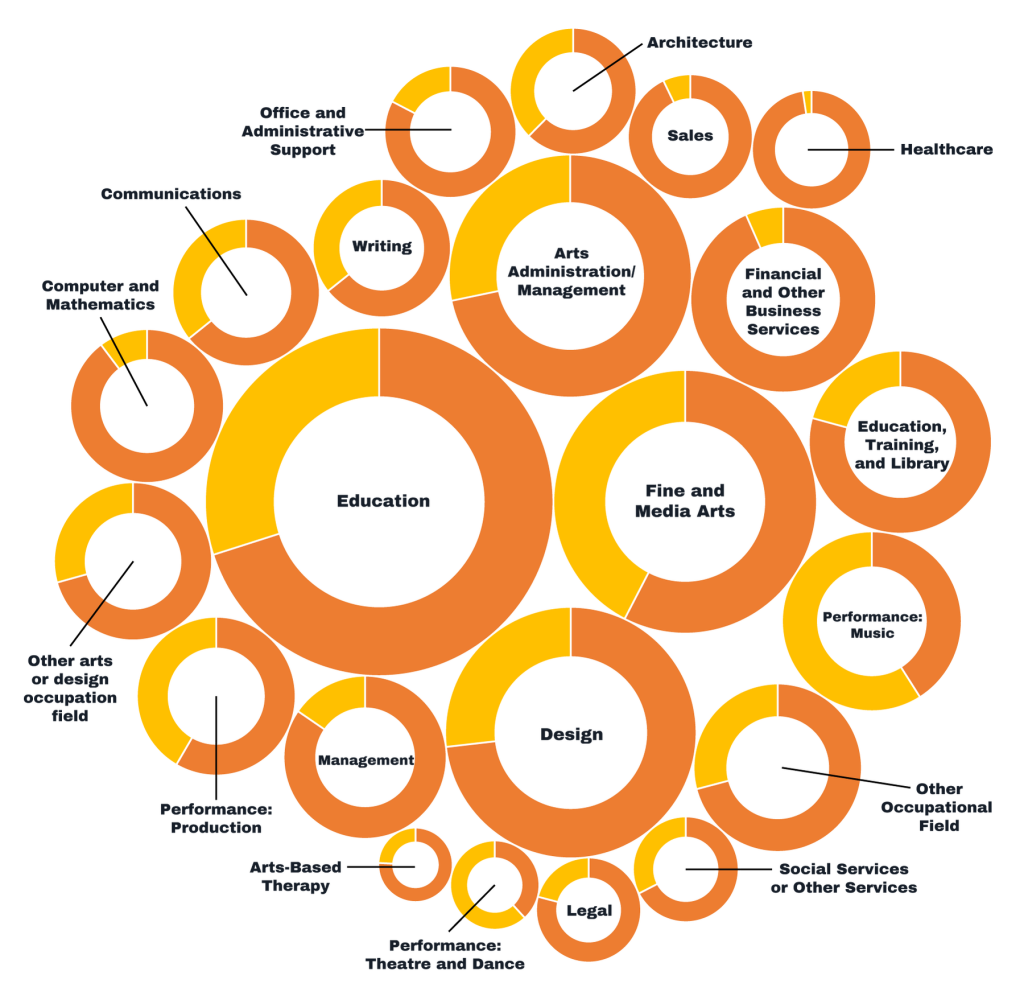
Arts and design alumni across the United States are navigating a mix of opportunities and evolving dynamics in today’s workforce, according to the latest SNAAP Pulse survey. With 84% employed and 57% working full-time in the arts, most graduates report professional satisfaction and financial security — while also identifying issues, such as the rise of artificial intelligence, funding considerations, and changing government policies — as factors shaping their work.